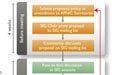
APNIC Document identity

Title:

APNIC Document Review Policies and Procedures

Short title:

doc-review-policy

Document ref:

APNIC-083

Version:

001

Date of original publication:

1 December 2001

Date of this version:

1 December 2001

Review scheduled:

n/a

Obsoletes:

n/a

Status:

Active

Comments:

n/a


APNIC Document Review Policies and Procedures

1

Introduction

APNIC (the Asia Pacific Network Information Centre) is the non-profit Regional Internet Registry for the Asia Pacific region. It is responsible for distributing public Internet address space and related resources in this region and for developing and implementing policies to manage that distribution.

To ensure fair representation of the interests of all members, these policies are developed through a consensus process that APNIC facilitates in an open, consultative environment. APNIC is responsible for documenting and disseminating the policies that result.

This document describes the policies and procedures to be followed by APNIC in meeting its documentation responsibilities.

2

Scope

This document describes the policies and procedures that apply to APNIC official documents. It relates to the development, revision, translation, accessibility, and archiving of these documents.

3

Definitions


3.1

Official documents

Official documents are documents created by APNIC to describe:

  • policies;
  • membership rights and obligations;
  • legal relationships; and
  • other matters directly affecting the interests and operations of the members or their relationship to APNIC.

Documents that are not official documents for these purposes include:

  • reports, proposals and presentations;
  • brochures and similar informational materials;
  • forms; and
  • general web site content.
 

3.2

Document review

In this document, "document review" refers to the process of creating, developing, or revising official documents.


3.3

Public drafts

Public drafts are the drafts of official documents that APNIC makes public on its web site or distributes through open mailing lists.


3.4

Active date

The active date of a document is the date at which the document is considered as implemented. From the active date, the contents of the document become active as official APNIC policies or procedures.


3.5

Provisionally active

Provisionally active documents are those that may be relied upon in draft form before the end of the review period.

4

Objectives

With these document review policies and procedures, APNIC's objectives are:

    (a) Fairness – to ensure that development of APNIC documents fairly represents the interests of the community as a whole;
    (b) Openness – to ensure that all members of the APNIC community have the opportunity to participate in the development of APNIC documents;
    (c) Certainty – to ensure that all members can make informed decisions, on the basis of a clear and predictable system for review of official documents.

5

Language

With these document review policies and procedures, APNIC's objectives are:


5.1

Official language

To provide the fairest possible access to APNIC information and resources across the entire region, all APNIC official documents will be published in English.


5.2

Translated documents

APNIC allocates resources from each annual budget for the translation of APNIC documents into other languages of the region. It may not be possible to translate all APNIC documents or provide translations in all of the languages of the region.

Regardless of any translations made, the English language version published by APNIC will remain the official document.

6

Document review procedure


Step 1:

Propose review

APNIC proposes a document review. This can be done on the initiative of the Secretariat, or by request of the membership or Executive Council, or by a consensus decision reached at an APNIC Open Policy Meeting.


Step 2:

Call for comments

APNIC issues a call for comments by making an announcement on relevant mailing lists and posting a notice on the APNIC web site. (See Schedule B for the requirements of Calls for Comments.)


Step 3:

Incorporating comments

Following the close of a call for comments, APNIC will consider all the comments received and prepare a revised draft of the document. APNIC will also prepare a summary of the comments received the amendments made from the previous draft.

APNIC will publish the revised draft and the summary of comments.

[Depending on the category of review (see Schedule A), steps 2 and 3 may be repeated]


Step 4:

Final call for comments

Depending on the review category (see Schedule A), the final iteration of this review process will commence with a "Final Call" for comments. The contents of the Final Call will be similar to a normal call for comments, but it will include details of APNIC’s intention to prepare a final version of the document for approval and implementation.


Step 5:

Approval of document

APNIC will prepare a final version of the document.

If the review was conducted under categories A or B, APNIC will present the final version to the Executive Council to consider. The Executive Council may either approve the document, request particular amendments, or request a further round of revision.

In the case of documents reviewed under category A, the Executive Council may require that approval of the final document be subject to membership vote.

If the review was conducted under category C, APNIC may approve the document without seeking further approval.


Step 6:

Implementing documents

Once a document has received final approval, it will be assigned an active date in accordance with Schedule A.

At any stage in a review, APNIC may make a document provisionally active; however, in the case of category A and B reviews, APNIC must first seek the consensus of the APNIC Member Meeting or the permission of the Executive Council. A document will not be made provisionally active unless APNIC (or the Executive Council, as the case may be) is satisfied that no members are likely to be adversely affected.

7

Obsoleting documents

If the approved document is intended to replace an existing document, then that former document will remain active until the approved document is implemented.

8

Publishing documents

APNIC official documents will, in most cases, be published in text (.txt) and HTML file formats. HTML documents may differ from the text versions by way of the inclusion of hyperlinks, formatting, and graphics; however, in case of any differences in content, the text version will be considered to be the official document.

In some cases, particular layout requirements may require that the official document is published in Portable Document Format (.pdf) or similar format.

During the review process, all public drafts and summaries of comments produced will be available on the APNIC web site for public reference.

9

Labeling documents

APNIC official documents will be labeled with the following information:

  • document name;

  • APNIC document reference number;

  • approval date;

  • active date;

  • scheduled date for next review, if applicable;

  • list of any documents obsoleted by implementation.

In addition, if an official document has been obsoleted, the labeling of the document will identify the document that obsoleted it and the date it was obsoleted.

Schedule A


Categorising documents

APNIC recognises that a responsible document review process must balance the need for general progress with the need to consider impacts on members. Therefore, when APNIC starts a document review, it will first determine the nature of the review in terms of the following categories:

  1. Substantial revisions affecting areas of significant core policies and procedures, membership fees and other financial obligations, or major issues affecting membership rights and obligations;

  2. Minor revisions affecting policies and procedures;

  3. Error correction, typographical and stylistic revisions, document labelling, and revisions and developments affecting minor procedures and guidelines.


General category guidelines

When evaluating the review category, APNIC will consider a range of factors relating to the significance of the review, including:

  • the impact upon the membership rights and obligations of members (including fees and other financial obligations);

  • the length and complexity of the relevant document (including the impact that may have on translation needs);

  • the nature of the content under review (that is, whether it amends policies, improves procedures, or merely provides explanatory information);

  • the urgency of the review, in response to changes within the Internet environment;

These factors are to be used as guidelines only and are not intended to be subject to strict definition.


Requesting re-categorisation

At any stage in the document review process, any member may request in writing that the review be re-categorised. APNIC will in general accept such requests.

If APNIC declines the request, it will provide a written explanation to the member who made the request. If the member disputes that explanation then APNIC will immediately refer the request to the Executive Council, which will have the final decision as to the appropriate category for the review.


Summary of categories

Category

Total review period

Expected no. of calls for comment

Period for each call for comment

When implemented?

A

6 months

at least 2 plus final cfc*

6 weeks

(can be 4 weeks for final cfc)

active date set 3 months from approval

B

4 months

at least 1 plus final cfc

4 weeks

active date set 1 month from approval

C

1 month

at least 1, which may be a final cfc

4 weeks

effective from date of approval

* cfc = call for comments

Schedule B


Form of calls for comments

The announcement and notice for a call for comments will:

  • identify the document to be revised, or, if no current document exists, the nature of the document to be developed;

  • briefly describe the reasons for the proposed review;

  • invite comments and suggestions from interested parties;

  • nominate a review category;

  • set out a schedule for the review, including deadlines for comments;

  • provide URLs for any related documents.

The contents of the final call will be similar to a normal call for comments, but it will include details of APNIC’s intention to prepare a final version of the document for presentation to the Executive Council.


    Requesting a further review

    If a member believes that any of the objectives in section 4 will not be served by proceeding with a final call for comments, then they may request further review of the document, in writing, to APNIC.

    If APNIC receives such a request then it may either announce an additional call for comments (including the details of the request in the summary of comments), or decline the request.

    If APNIC declines the request, it will provide a written explanation to the member who made the request. If the member disputes that explanation then APNIC will immediately refer the request to the Executive Council, which will have the final decision as to whether to proceed with the final call for comments or to require an additional call for comments.